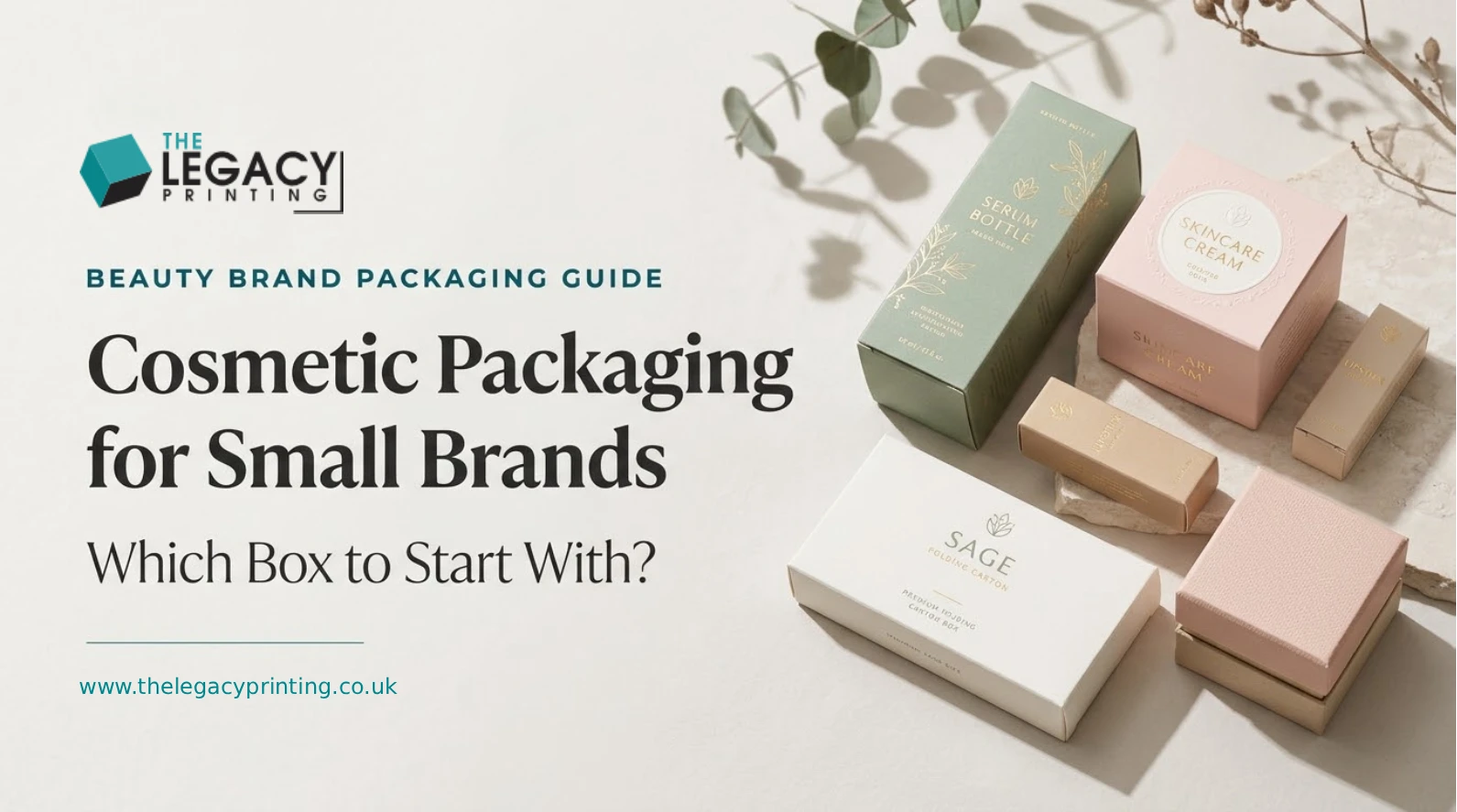
UK cosmetics labelling rules cover the box, not just the bottle. Key details must appear on both the container and its outer packaging. The lettering must be clear, easy to read and impossible to rub off. That makes your first box a labelling decision as much as a design one.
For most cosmetic packaging for small business launches, the safest first box is a printed folding carton. It's light, it arrives flat, it usually costs less per box, and it has room for your label text. Keep rigid boxes for gift sets or one hero product. If you sell online, add a mailer box for posting.
Cosmetic packaging for small business: which box should you start with?
Start with a folding carton unless you have a clear reason not to. It suits serums, creams, lip products and balms. With the right finish, it can look just as premium as a heavier box.
Folding carton for most first launches
A folding carton is a thin printed paperboard box. It arrives flat and you fold it up by hand. It's the box you see around most face creams and serums on a shop shelf.
It stores easily and prints sharply. It also gives you clean side and back panels for ingredients and other required text.
When a rigid box is worth it
A rigid box is thick and strong, and it arrives already built. It feels expensive in the hand. It also costs more to make, store and post.
We'd suggest one for a gift set, a launch kit or a high-price hero product. It's rarely the right first box for a whole range.
When a mailer box comes first
A mailer box is a sturdy box, often made from corrugated board, built for posting orders. Corrugated board has a wavy inner layer that adds strength. If you only sell online and never stock shops, a branded mailer may be your first order.
Most online brands still put a folding carton inside it. That way, the product looks right when your customer opens the parcel.
Folding carton vs rigid vs mailer: how do they compare?
Each box style does a different job. The table below compares them by price point, product weight, sales channel and storage.
| Feature | Folding carton | Rigid box | Mailer box |
|---|---|---|---|
| What it is | Thin printed paperboard box | Thick greyboard wrapped in printed paper | Sturdy corrugated box with a fold-in lid |
| Best for | Serums, creams, lip gloss, balms | Gift sets, perfume, hero products | Online orders and subscription boxes |
| Price point it suits | Everyday to premium | Premium and luxury | Any, as the outer pack |
| Product weight | Light to medium items | Heavier glass and multi-item sets | Several items or heavier orders |
| Main channel | Shops, online, markets | Gifting and special editions | E-commerce and PR sends |
| Storage | Delivered flat, small space | Built, takes more space | Delivered flat, folds up |
| Usual material | SBS (white board) or kraft | Rigid greyboard | E-flute or B-flute corrugated |
Still unsure? Look at where most of your sales happen. Shop shelves point to a folding carton, and gifting points to a rigid box. If you sell online only, start with a mailer, often with a carton inside.
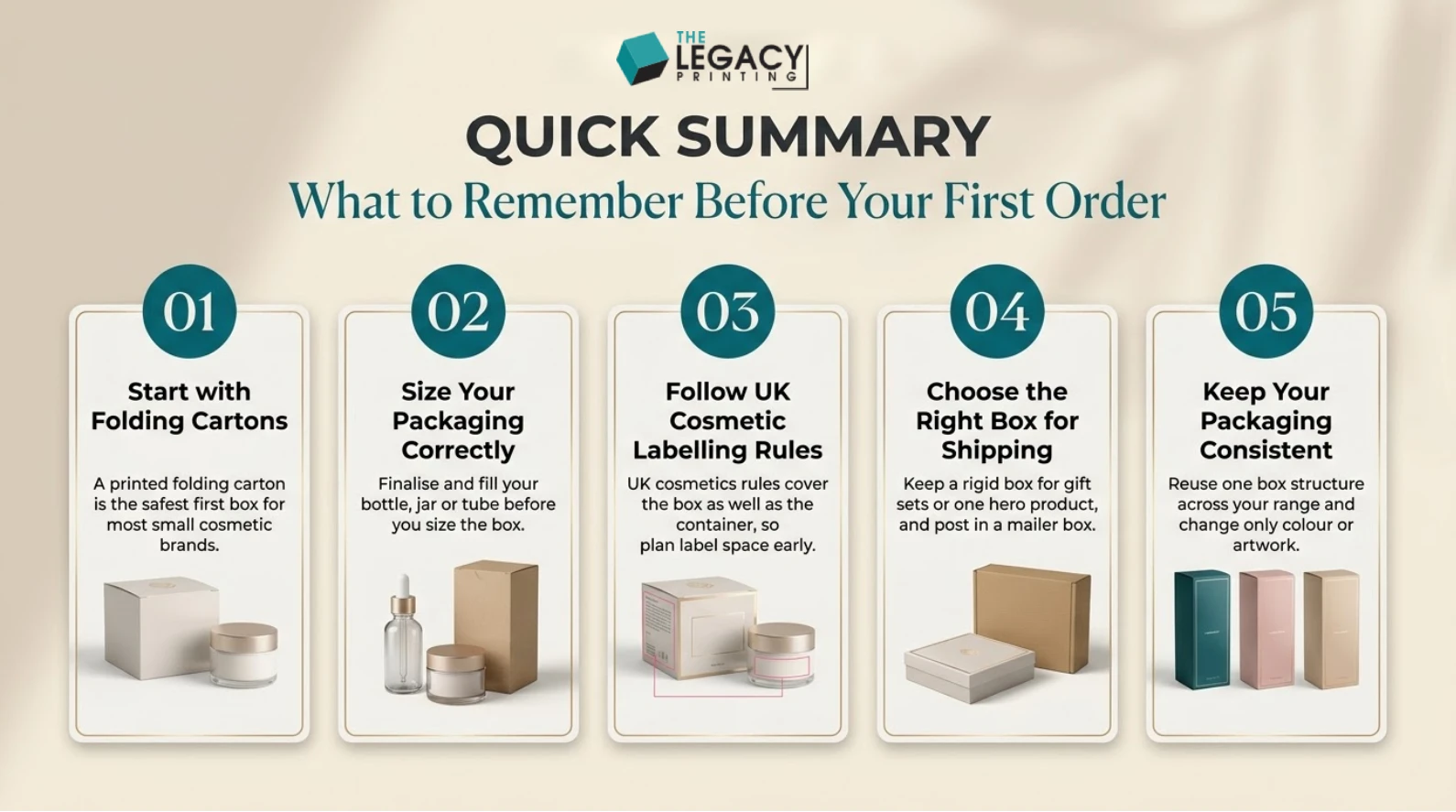
What to remember before your first order
Myths about custom cosmetic packaging, and the truth
Most costly packaging mistakes start with a belief that sounds sensible. Here are eight common ones among new skincare and cosmetic brands, with the facts behind each.
Myth: A small brand needs a rigid box to look premium
The truth: A folding carton can look and feel premium with the right finish. Soft-touch lamination is a thin film that makes the box feel smooth and velvety. Foil stamping presses a shiny gold or silver layer onto your logo. Spot UV adds a clear, glossy coat to one area only, such as your brand name.
You can read more in our guide to how spot UV printing works on custom boxes. In our view, a rigid box makes most sense once you have a gift set or a proven best seller.
Myth: You can design the box first and choose the bottle later
The truth: The box must be sized around the final container. Your bottle, jar or tube is the primary packaging, which means the part that touches the product. The box is the secondary packaging.
For example, say you switch bottle supplier after your boxes are printed. The new bottle may be only a few millimetres taller, but that can be enough to stop the lid closing. Lock the container first, fill a sample, then measure.
Myth: Labelling rules only apply to the bottle
The truth: UK cosmetics rules say required details must appear on both the container and the packaging. The lettering must be clear, easy to read and hard to remove. So plan label space on the box from the very first draft, rather than squeezing it in at the end.
Myth: Custom boxes only make sense if you order thousands
The truth: Our custom cosmetic boxes start from 50 boxes, and the exact quantity is confirmed in your quote. You may see this called the MOQ, or minimum order quantity: the smallest run a printer will make. A small run lets you test one product with real customers before you commit to a larger reorder.
Myth: Set-up charges make small runs poor value
The truth: We don't charge for dies or plates. A die is the cutting tool that shapes the box. Plates carry your artwork onto the printing press. Our quotes are itemised, so you can see exactly what you're paying for, with no surprises on price.
Myth: The colours on your screen will print exactly the same
The truth: Screens make colour with light, while print uses ink on board, so colours can shift. CMYK printing mixes four inks to make most colours. Pantone (PMS) is a single, exact pre-mixed ink. It helps when your logo colour must match on every reorder. A free digital proof and a sample kit let you check before production starts.
Myth: Every product needs its own box design
The truth: One box structure can often work across several SKUs. An SKU is one product version you sell, such as a 30 ml serum. Keep the same shape and size, then change the colour, a band of artwork or a printed sleeve for each product. Reorders stay simpler, and your range looks consistent on a shelf.
Myth: Kraft is the only eco-friendly choice
The truth: Kraft board has a brown, natural look, but it isn't your only option. White recyclable paperboard works too, and biodegradable boards are available. You can also choose soy or water-based inks.
If recycling matters to your customers, keep mixed-material extras to a minimum. Tell us your goal and we'll suggest finishes that suit it. Our eco-friendly box options show the boards we offer.
Myth vs fact at a glance
| Myth | Fact |
|---|---|
| Only rigid boxes look premium | Folding cartons with soft-touch, foil or spot UV can look premium |
| Pick the bottle after the box | Size the box around a final, filled container |
| Labels only matter on the bottle | UK rules cover the container and the packaging |
| Custom boxes need huge orders | Our runs start from 50 boxes |
| Small runs carry tooling fees | We charge no die or plate fees and itemise every quote |
| Screen colour equals print colour | Use Pantone for logo colours and check a proof |
| Each product needs a new box | One structure can serve a whole range |
| Kraft is the only eco option | Recyclable white board and soy or water-based inks also help |
What size box do I need for my serum bottle or cream jar?
Measure your filled container in millimetres, then let your packaging specialist set the inside size. Send the measurements with the cap or pump fitted, because that's the real height.
Measure in mm: height, width, depth
Use a ruler or calliper on a filled, closed sample. Write down three numbers. Height runs from the base to the top of the cap. Width is taken at the widest point, and depth runs front to back.
Round bottles and jars have the same width and depth. Tubes are often widest at the sealed, crimped end, so measure there.
Add room for pumps, caps and inserts
Pumps, droppers and tall caps can change the height a lot. Glass also needs to sit still so it doesn't knock against the box walls. An insert is a card piece inside the box that holds the product in place.
For a serum in a glass dropper bottle, an insert is often worth the extra step. Our article on custom serum box structures covers this in more detail.
Test with a filled sample
An empty bottle can behave differently from a full one. A filled sample shows the true weight and how the product sits. Ask for a sample kit, try the fit, and only then approve the dieline. A dieline is a flat map of the box with its cut and fold lines, so your artwork lines up.
For serums and creams, you can also ask about tamper-evident features. These include seals that show if a box has been opened and secure tuck flaps that stay closed in transit.
What must be printed on cosmetic packaging in the UK?
UK cosmetics rules list several details that must appear on the pack. Plan space for them on the back or side panels before any artwork is designed.
Common UK label items in plain words
- Responsible Person: the name and address of the business or person legally responsible for the product.
- Country of origin: needed for imported products.
- Nominal content: the amount inside, in g or ml.
- Batch number: a code that shows which production run the product came from.
- Precautions: any warnings for use.
- Function: what the product does, unless it's obvious from how it looks.
- Ingredients: the full list of what's in the product.
- Durability: a date of minimum durability isn't required when the product lasts more than 30 months.
One timing point matters now. Official UK guidance allowed a seven-year transition from 1 January 2021 before UK Responsible Person details must appear on labels, as long as EU responsible person details are shown. In practice, new artwork should carry UK details from 1 January 2028 at the latest. If you're designing boxes you'll still be using in 2028, it's safer to add UK details now.
Back and side panel layout
Keep the front panel for your brand and product name. Put the ingredients and Responsible Person address on the back or a side panel. If the batch number is added after printing, leave a clear, unprinted area for it.
Apart from net content, there's no minimum text size for these items. Even so, tiny text helps nobody, so give it room.
Your brand supplies the approved wording
We print the text you supply and help it fit neatly on the box. The wording itself, and whether it meets the rules, is your brand's responsibility. Have your artwork checked by someone experienced with UK cosmetics rules before you approve the proof.
It also helps to know the difference between optional and required. Certification of ingredients or finished products is optional. Following the UK cosmetics rules is not.
What affects the cost of custom cosmetic packaging?
Cost depends on six things: box style, size, material, print, finish and quantity. That's why we quote each order on its own rather than list fixed prices.
Style, size, material, print, finish, quantity
A rigid box costs more than a folding carton of the same size, and larger boxes use more board. Pantone inks, foil and embossing each add a step. Embossing pushes a pattern up so you can feel it, while debossing presses it down. Larger quantities usually bring the cost per box down, which helps when you move to bulk reorders.
Why no die or plate charges helps small runs
On a small order, one-off set-up fees can take up a big share of the total. We don't charge them. Your itemised quote shows each part of the price, so you can drop or swap a finish and see the effect straight away. New customers also save 20% on their first order.
Reusing one structure across your range
Packaging costs for a small business are easier to manage with fewer unique sizes. For example, if your 30 ml serum and 30 ml oil use the same bottle, give them the same box and change only the colour. It's one of the simplest ways to keep reorders quick and tidy.
What to do instead: a safe first-order checklist
Follow these steps in order and you'll avoid the most expensive mistakes. Each one comes from the myths above.
- Finalise your bottle, jar or tube, and fill a sample.
- Measure it in mm with the cap or pump on.
- Choose a folding carton for your first launch unless you need a gift box.
- Get your label wording checked and plan space for it on the box.
- Pick one structure you can reuse across your range.
- Choose one or two finishes, not five.
- Use Pantone for your logo if colour matching matters.
- Order a sample kit and approve the free digital proof.
- Start with a test run, then reorder once sales are proven.
How a first order works with us
Send us your product, size, quantity and preferred finish, and we'll reply to your quote request within 1 hour. Our free design support covers artwork and dieline set-up. Changes to the free digital proof cost nothing. Most orders are produced in 8–12 working days after proof approval, plus delivery time, and rush production can often be arranged.
Boxes arrive flat to save storage space, with free UK delivery to England, Scotland, Wales and Northern Ireland. One packaging specialist looks after your order from quote to delivery. If you post orders, our guide to mailer boxes for UK e-commerce explains how to pair a carton with a postal box.
Frequently Asked Questions
What is the best packaging for a small cosmetic business?
For most small cosmetic brands, a printed folding carton is the safest place to start. It's light, arrives flat, usually costs less per box and has space for label text. Add a mailer box for online orders and a rigid box for gift sets.
Should a small skincare brand use folding cartons or rigid boxes?
Most small skincare brands should start with folding cartons. A soft-touch or foil finish gives a premium feel at a lower cost. Rigid boxes work best for gift sets, launch kits or one hero product.
Can I put the ingredients list on the box instead of the bottle?
It depends on the item and your product, so check with someone experienced with UK cosmetics rules. The rules require key details on both the container and the packaging. Some items, such as the batch number, may appear on the box only when the container is too small to carry them. Confirm the final wording before you approve the proof.
What is the minimum order for custom cosmetic boxes?
Our custom cosmetic boxes start from 50 boxes. The exact quantity for your style and finish is confirmed with your quote.
How long does custom box production take?
Most orders are produced in 8–12 working days after proof approval, plus delivery time. Rush production can often be arranged, so ask when you request your quote.
Are your cosmetic boxes recyclable?
We offer recyclable and biodegradable boards, plus soy or water-based inks. Some finishes and mixed-material extras can affect recycling. Tell us your goal and we'll suggest suitable options.
Do you charge for dies or plates?
No. We never charge for dies or plates. Every quote is clear and itemised, so you know what you're paying for before production starts.
Next step: get your boxes quoted
A good first box doesn't need to be complicated. Lock your container, choose a folding carton, leave room for your label text and test a small run. Browse our custom cosmetic packaging to see the styles, boards and finishes we make for skincare and beauty brands. Our customers always come first, and we're happy to talk through your product before you commit.
Ready to create your boxes? Get a free quote within the hour, from 50 boxes, with free design support and free UK delivery.