Good pharmaceutical packaging in the UK comes down to five checks. Pick the right carton style. Choose the right board. Leave clear space for Braille, batch and expiry codes. Add a tamper-evident closure if your product needs one. Then match your artwork to the approved wording, word for word.
Miss one of these and you risk a reprint, a delayed launch or a pack that fails final checks.
Use this checklist when you plan custom medicine boxes, supplement boxes or pharmacy cartons. It works for a first order, a change of supplier or a redesign. Go through it before you ask for a quote, and you'll get a faster, more accurate price.
One point first. We design and print the box. Your regulatory team, or whoever holds the product licence, decides which rules apply and supplies the approved text. This checklist helps you build a carton around those decisions. It is not legal advice.
What is pharmaceutical packaging, and which part do we print?
Pharmaceutical packaging is everything that holds, protects and identifies a medicine. That runs from the bottle that touches it to the case it travels in. We print the middle layer: the carton your customer sees and handles.
Primary, secondary and tertiary packaging
There are three main types of pharmaceutical packaging:
- Primary packaging touches the medicine itself. For example, a blister strip, a glass dropper bottle, a tube or a sachet.
- Secondary packaging is the box or carton around the primary pack. It carries the name, the codes, the Braille and often the leaflet.
- Tertiary packaging is the larger outer case that moves many packs together, such as from a warehouse to a pharmacy.
Where custom medicine boxes fit
Custom medicine boxes are secondary packaging. Most are pharmaceutical cartons, also called folding cartons. These are paperboard boxes printed flat, then folded and glued into shape.
They're light, they print sharply and they hold a lot of information in a small space. That's why you see them on almost every pharmacy shelf.
Before you design: the product and pack checklist
Start with the product, not the artwork. The carton has to fit the primary pack, protect it and leave room for every line of text it must carry.
- Measure the primary pack in mm: height, width and depth. Include the cap or dropper, not just the bottle.
- Note the weight. A heavy glass bottle needs a stronger base than a light blister strip.
- Decide if a folded leaflet goes inside, and measure how thick it is once folded.
- Count the units per carton. One bottle? Two blister strips? Thirty sachets?
- Ask your regulatory team which features your product needs: Braille, tamper evidence, child resistance, "UK Only" marking or a 2D barcode.
- Decide where the carton will be sold: on a pharmacy shelf, behind the counter or by post.
- Agree your order quantity. Small test runs and large reorders both work.
Choose the carton style for your product
Match the style to what goes inside. Here are the main options in plain words:
- Tuck-end carton: flaps at the top and bottom tuck in to close. Simple, and good for light items.
- Crash-lock or auto-lock bottom: the base snaps into place when you open the flat carton. It's faster to pack and stronger under weight.
- Sleeve: a printed band that slides over a tray or inner box.
- Two-piece box: a separate base and lid.
- Rigid box: thick greyboard wrapped in printed paper. Best kept for premium gift sets, not everyday medicines.
| Primary pack | Suggested carton style | Suggested board | Why |
|---|---|---|---|
| Blister strips | Tuck-end carton | Folding boxboard (SBS) | Light load. Flat shape. Lots of print space. |
| Glass bottle or dropper | Crash-lock bottom with tuck top | Heavier SBS, with an insert if needed | The base takes the weight. An insert stops the bottle moving. |
| Tube of cream or gel | Slim tuck-end carton | SBS | Narrow shape. A clean surface for small text. |
| Sachets | Tuck-end or crash-lock carton | SBS or kraft | Holds a stack without bulging. |
| Supplement jar or tub | Crash-lock carton or sleeve | SBS or kraft | Strong base. Kraft gives a natural look. |
| Packs sent by post | Postal box around the cartons | Corrugated E-flute or B-flute | Extra crush protection on the way. |
Pick the right board
For most pharmaceutical cartons, smooth white folding boxboard is the safest choice. Small text and fine lines print very clearly on it.
- SBS (folding boxboard): smooth white paperboard with sharp print. Our first pick for medicine cartons.
- Kraft: strong brown board with a natural look. Often chosen for supplements and herbal products.
- Corrugated E-flute or B-flute: board with a wavy middle layer. E-flute is thinner. B-flute is thicker and stronger. Both suit postal boxes and outer packs.
- Rigid greyboard: thick, stiff board for luxury sets and gift boxes.
Want a greener carton? We offer recyclable and biodegradable boards, kraft, and soy or water-based inks. See our eco-friendly box options for details.
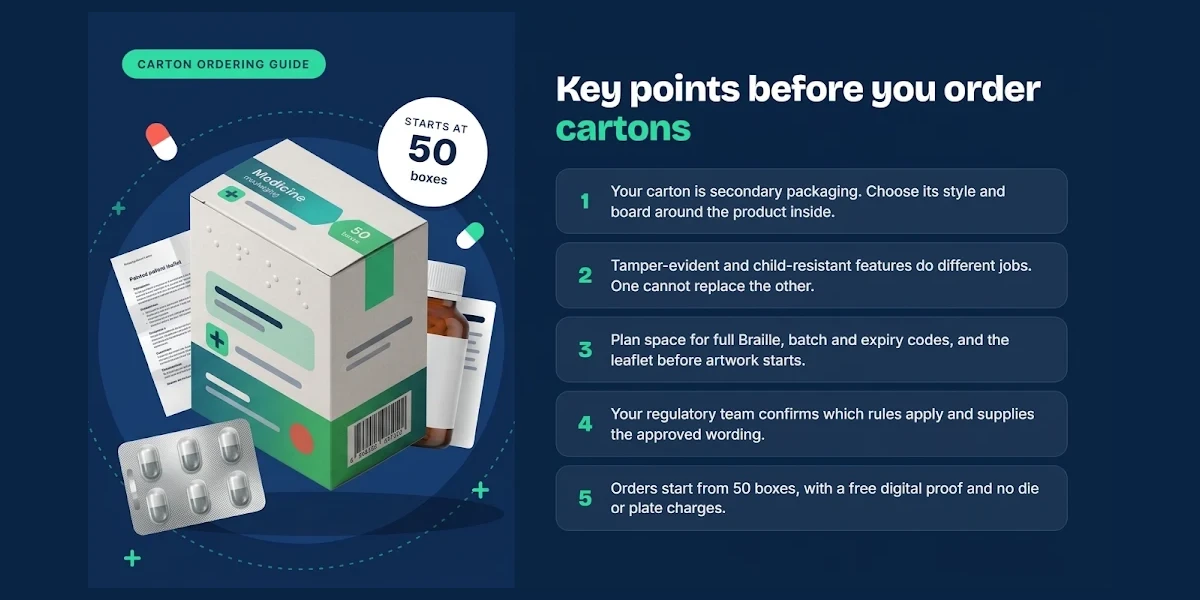
Key points before you order cartons
Tamper-evident vs child-resistant: what is the difference?
A tamper-evident pack shows if someone has opened it before you. A child-resistant pack is hard for young children to open. They do different jobs, and one cannot stand in for the other.
| Feature | Its job | Common examples | Who confirms it is needed |
|---|---|---|---|
| Tamper-evident | Shows clearly that a pack has been opened | Glued end flaps, tamper seals, tear strips, bands | Your regulatory team |
| Child-resistant | Makes a pack hard for young children to open | Special closures and pack structures | Your brand, through testing against a recognised standard |
Tamper-evident closures on cartons
On a printed carton, tamper evidence means the box can't be opened without visible damage. A glued flap tears, a seal breaks or a strip has to be pulled off.
For some medicines, an anti-tamper device is required by the rules that apply to them. For others, it's a choice. Don't guess. Ask your regulatory team, then tell us what you need. We'll plan the closure into the dieline, which is the flat template that shows every cut and fold.
Child-resistant options, and why "child-proof" is the wrong word
No pack is child-proof. Child-resistant packaging is a last line of defence, so medicines should still be kept out of reach.
Under UK rules, some child-resistant packs only count as child-resistant once they've been tested against a recognised standard. That testing sits with your brand and its pack suppliers. A common mistake is treating a child-resistant feature as the tamper seal. Plan each one on its own.
During artwork: the information space checklist
Running out of room late in artwork often means starting the layout again. Plan the space for each required item before anyone touches colours or logos.
- Product name: clear and easy to read from the front.
- Braille: UK medicine rules say the product name must appear in Braille on the outer packaging. Write it out in full, because shortened (contracted) Braille is not allowed. The official UK Braille code since 2016 is Unified English Braille. Braille can appear on more than one side of the carton.
- Batch number and expiry date: leave a clear, uncoated panel so these codes can be printed or stamped later and stay readable.
- Leaflet: allow room inside for the folded patient information leaflet, or plan a holder.
- Printed directly: for licensed medicines, all packaging information must be printed directly onto the pack, not added later as a loose sticker.
- Legible text: UK rules say packaging information must be easy to read, easy to understand and hard to rub off. Official best-practice guidance sets a 7 point minimum font size for information on blister foil. We suggest treating that as a floor for small text on cartons too.
- Folds and edges: keep key text away from creases and glue flaps.
"UK Only" marking and the 2D barcode, in plain words
From 1 January 2025, shared packs used across several markets can no longer enter the UK supply chain. Medicines now need a UK-specific outer carton marked "UK Only". If you're moving away from a shared pack, expect new artwork.
The 2D barcode is a small square code, also called a data matrix. It holds the batch number, expiry date, product code and a serial number for that single pack. Giving each pack its own number like this is called serialisation.
These safety features came in on 9 February 2019. They stopped applying in Great Britain after the UK left the EU, but the rules for Northern Ireland have differed. If you sell into Northern Ireland, ask your regulatory team what your carton needs. We'll leave the right space for it.
Who supplies the approved wording
The UK medicines regulator approves all packaging and labelling information for medicines sold in the UK. So your brand supplies the approved text, codes and Braille wording, and we set it into the layout exactly as supplied.
One tip: keep patient details and private data out of the artwork files you share. The carton only needs the approved product information.
Best pharmaceutical packaging design: finishes and print that stay readable
The best pharmaceutical packaging design looks calm and clear. Finishes should build trust, not fight the information.
We print on offset and digital presses. CMYK mixes four inks to make full colour. Pantone (PMS) is one exact, pre-mixed ink, which helps your brand colour match on every reorder. On a pharmacy shelf, that matters. A pack that changes shade can look like a different product.
Finishes we offer include:
- Matte, gloss or soft-touch lamination: a thin film over the print. Soft-touch feels velvety.
- Spot UV: a shiny coating on chosen areas only, such as a logo. Our guide to spot UV printing explains how it works.
- Gold, silver or holographic foil: a metal-look finish.
- Embossing and debossing: raised or pressed-in shapes.
- Die-cut windows: a cut-out that shows the product inside.
Our honest view: on a medicine carton, keep heavy finishes on the front panel. Gloss film or soft-touch over the batch and expiry zone can make codes harder to print and read. Foil next to small text can cause glare. If in doubt, leave that area plain.
Supplement boxes and pharmacy boxes UK: what changes?
Supplement boxes and general pharmacy boxes can fall under different rules from licensed medicines. Many of the same features still earn their place.
If your supplement isn't a licensed medicine, rules such as Braille or "UK Only" marking may not apply in the same way. Even so, a clear ingredients panel, room for batch and best-before codes and a tamper seal all help buyers trust what they pick up. Ask your regulatory team what applies, and we'll build the carton around it.
Pharmacy boxes cover a wide range, from own-brand products to shelf-ready trays. Some sit close to skincare, such as medicated creams or balms. If your range crosses into beauty, our cosmetic and skincare packaging uses the same boards and finishes. For counter displays and window cartons, see our retail boxes. You can also browse packaging by industry to compare options.
After artwork: the proof, order and delivery checklist
Once the layout is ready, ordering is simple. Send the right details and you'll get an accurate, itemised quote within the hour.
- Send your details: product type, size in mm, quantity, board and finish. Unsure about any of these? Say so, and we'll suggest a style and material.
- Use our free design support: we set up the dieline and help with the layout, including Braille and code zones.
- Check the free digital proof: compare every word against your approved text. Changes to the proof are free.
- Confirm the quote: orders start from 50 boxes. There are no die or plate charges, and every quote is itemised, so there are no surprises on price.
- Plan the timing: most orders are produced in 8–12 working days after proof approval, plus delivery time. Rush production can often be arranged.
- Delivery: free UK delivery to England, Scotland, Wales and Northern Ireland. Boxes arrive flat to save space.
- Want to feel the board first? Order a sample kit. We follow up sample requests within 2 hours.
When you compare pharmaceutical packaging services, ask every supplier the same three questions. Is there a die charge? Is the proof free? Who looks after the order? With us, one packaging specialist stays with your order from quote to delivery.
Pharmaceutical carton check table: what to check, why, red flag
Run through this table on your final proof. Each red flag is an easy problem to miss and an expensive one to fix after printing.
| What to check | Why it matters | Red flag |
|---|---|---|
| Carton size against the real product | A loose fit lets bottles move and break | Size based on the bottle only, not the cap or dropper |
| Base style for heavy items | A tuck bottom can open under weight | Glass bottle in a plain tuck-end carton |
| Braille text | The name must appear in full Braille | Shortened Braille, or no zone left for it |
| Batch and expiry panel | Codes must stay readable | Panel covered by gloss film or soft-touch |
| Text size and contrast | Information must be easy to read | Tiny grey text on a pale background |
| Text near folds | Creases can split words | Dosage text running over a fold line |
| Leaflet space | The leaflet must fit without forcing the box | Carton bulges once the leaflet is inside |
| Wording against approved text | Only approved text should go on the pack | Text retyped from memory, not copied from the approved file |
| Tamper and child features | Each one does a different job | Child-resistant closure treated as the tamper seal |
Printable summary: your one-page pharmaceutical packaging checklist
Print this list and tick it off before you approve your proof.
- Product measured in mm, including cap and leaflet.
- Carton style chosen for the weight and shape.
- Board chosen: SBS, kraft, corrugated or rigid.
- Required features confirmed by your regulatory team.
- Tamper-evident closure planned, if needed.
- Child-resistant needs checked separately.
- Full Braille zone placed on the dieline.
- Clear, uncoated panel left for batch and expiry.
- "UK Only" and 2D barcode space added, where they apply.
- Text large, clear and away from folds.
- Finishes kept off code and small-text areas.
- Proof checked word for word against approved text.
Frequently Asked Questions
What is pharmaceutical packaging?
It's the packaging that holds, protects and identifies a medicine. It has three layers. Primary packaging touches the product, secondary packaging is the printed carton, and tertiary packaging is the outer case used for transport.
What are pharmaceutical packaging materials?
For cartons, the main material is folding boxboard (SBS). Kraft, corrugated board and rigid greyboard cover other uses. SBS is the usual choice because small text prints very clearly on it. Corrugated board suits postal boxes and outer packs.
How do you design medicine packaging?
Start with the product size and the approved wording, then build the artwork around them. Plan space for Braille, batch and expiry codes and the leaflet first. Add brand colours and finishes last. Our free design support and free digital proof help at each step.
What is serialisation in pharmaceutical packaging?
Serialisation means giving each pack its own unique code. This is usually a 2D barcode holding the batch number, expiry date, product code and a serial number. Whether your carton needs one depends on your product and market, so check with your regulatory team.
Is medicine packaging recyclable?
Paperboard cartons usually are, especially when made from recyclable board with soy or water-based inks. Heavy plastic lamination and mixed materials make recycling harder. Our eco-friendly boxes are a good place to start.
How do you recycle medicine packaging?
Separate the parts first: the card carton, the paper leaflet and the blister or bottle. The carton and leaflet can usually go in card and paper recycling. Don't put unused medicines in household bins. Ask your local pharmacy about taking them back.
What is the minimum order for custom medicine boxes?
Orders start from 50 boxes, and your exact quantity is confirmed with your quote. That makes small trial runs possible before you reorder in bulk.
Ready to create your boxes?
Bring us your product size, quantity and the features your regulatory team has confirmed. We'll suggest the right carton and board and set up the dieline for you.
You'll get a free digital proof and a clear, itemised quote with no die or plate charges. Our customers always come first, and you can save 20% on your first order.
Get a free quote within the hour, from 50 boxes, with free design support and free UK delivery.