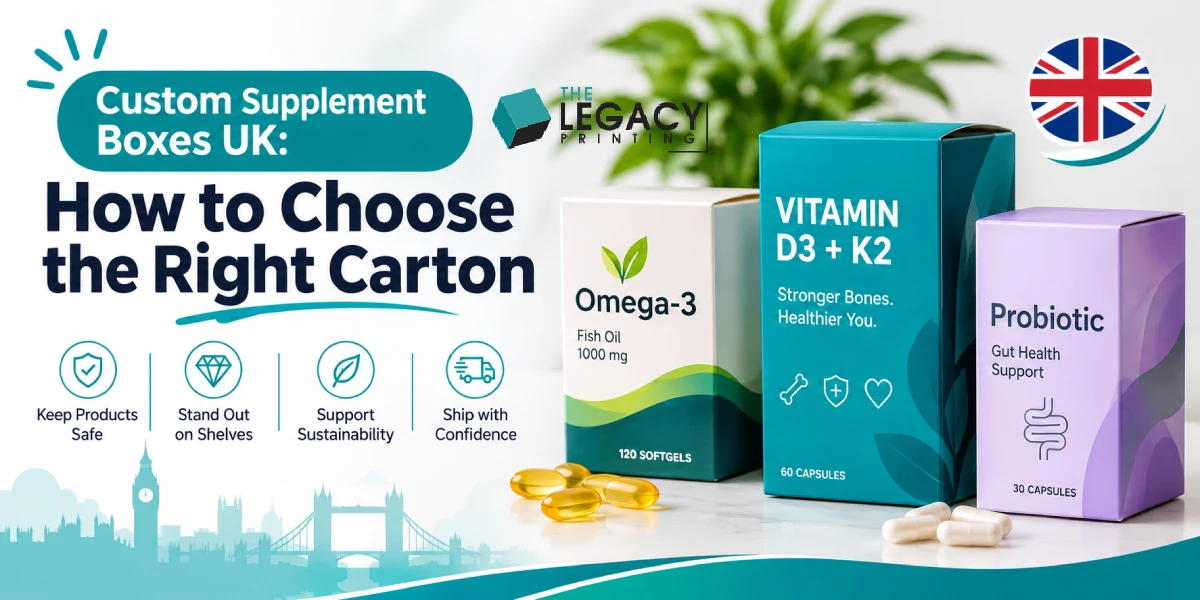
A common mistake with supplement boxes is choosing the box first and fitting the label in afterwards. The better order runs the other way. Start with the words and codes the box must carry. Then size the carton around your bottle, tub or sachets. Only after that should you choose the style, board and finish.
Why does the order matter so much? Each choice limits the next one. If you pick the box first, the label has to fit whatever space is left. You can end up with a lovely box and an ingredient list printed too small to read. Each step below explains what to decide and why it sits where it does.
Which supplement box fits your product? The quick answer
For most vitamin bottles, capsule packs and powder tubs, start with a folding carton in white board with a tamper-evident feature. The table shows what you'll need at each stage, roughly how long it takes and what you get back.
| What you need | Time | Result |
|---|---|---|
| Your product (bottle, tub, sachets or blister strips), a ruler, and your label wording | A quote reply within 1 hour of your request | A clear, itemised quote with no die or plate charges |
| Your artwork, or a brief for our free design support | Depends on how many proof changes you ask for | A free digital proof to check before printing |
| Proof approval | Most orders take 8–12 working days after approval, plus delivery time | Printed boxes delivered flat, with free UK delivery |
How to choose custom supplement boxes in 7 steps
Work through these steps in order. Each one depends on the answer to the step before it. If you skip ahead, you'll often have to go back and change something later.
Step 1: List everything the box has to carry
Write down every piece of information that must appear on the outer box. For dietary supplement boxes, that usually means:
- Product name and brand
- Ingredients list
- Directions for use
- Warnings
- Batch number and expiry date (codes that trace a production run and show the use-by date)
- Barcode (the lines a shop scanner reads)
Your brand supplies the approved wording. UK food supplement labelling rules decide what has to be shown, so check the text with whoever handles your labelling before artwork starts. Our job is to give that text enough room and print it clearly.
Why this comes first: a long ingredient list needs a certain amount of space to stay readable. Moving house works the same way. You count the furniture before you book the van, not after. For example, a supplement with a short list of ingredients might fit on one side panel. A blend with many ingredients may need a wider panel, or a taller box.
Step 2: Measure your container in mm
Measure the product itself, not a box you already have. For a bottle, measure:
- Height with the cap or dropper on
- Width at the widest point, which is often the shoulder or the cap
- Depth, if the bottle is square or oval rather than round
For a powder tub, measure the lid as well as the body, because lids are often wider. For sachets or stick packs, stack the number you plan to sell in one box and measure the whole stack. For blister strips, measure the strip and allow room for a folded leaflet.
The box also needs a little extra space so the product slides in easily. That gap is called clearance. Shoes are a good comparison. Too tight and they're hard to get on. Too loose and your foot slides around. The right clearance depends on the board thickness and the container shape, so ask our team for the exact figure rather than guessing.
Step 3: Decide how the box reaches your customer
A carton on a shop shelf and a box sent through the post do different jobs. One needs to look good standing still. The other needs to survive being handled, stacked and carried. Answer this question before you pick a style.
- Retail shelf: a printed folding carton (a thin card box delivered flat and folded into shape) that stands up and shows the front panel well.
- Online orders: the same carton, but often posted inside a sturdier outer box.
- Supplement subscription boxes: a corrugated mailer box (a strong posting box) that holds several products and still looks good when opened.
If you sell online, our guide to mailer boxes for UK e-commerce covers postal and mailer box choices in more detail.
Step 4: Pick the carton style
The style is the shape of the box and the way it opens and closes. Choosing one is a bit like choosing a door: you want it to open easily, close firmly and take the weight it carries. The main options for supplement packaging boxes are:
- Tuck-end: a flap tucks into the front. Simple and good value.
- Reverse tuck end: the top and bottom flaps tuck in opposite directions. Very common for slim cartons.
- Crash-lock (auto-lock) base: a pre-glued base that pops open and locks. It holds heavier glass bottles and tubs better than a tucked base.
- Seal-end: the ends are glued shut, so the box has to be torn to open.
- Sleeve: a band of card that slides over a tray or tub.
- Pillow box: a curved box that suits small, light items such as a few sachets.
- Window box: any style with a die-cut window (a cut-out that shows the product).
Our view: for a heavy glass bottle, a crash-lock base is worth it. A tucked base can push open under the weight when someone picks the box up from the top.
Step 5: Add a tamper-evident feature
A tamper-evident box shows a clear sign once it has been opened. That isn't the same as tamper-proof, which would mean it can't be opened at all. We use the right word on purpose, and we'd suggest you do too.
Think of the wax seal on an old letter. It doesn't stop anyone opening the letter, but you can see straight away if someone has. Our options work the same way. A tear strip is a thin strip you pull to open the box, and it can't be put back. A seal label sits across the opening and breaks when the box is opened. A seal-end carton also shows opening, because the glued end has to be torn.
Some products may need child-resistant packaging, meaning packs made hard for young children to open. That needs a specific design, so ask our team which options suit your product.
Step 6: Choose the board and the print method
Board is the card the box is made from. Picking board is like picking fabric for a coat: the same shape can feel light and smooth, or thick and sturdy. The main choices are:
- White SBS / folding boxboard: smooth white card that prints sharply. It gives a clean, clinical look.
- Kraft: brown, natural-looking card with an earthy feel.
- Corrugated (E-flute or B-flute): card with a wavy layer inside, which makes it stronger. Best for postal boxes.
- Rigid greyboard: thick, stiff board for premium gift sets.
We print with offset and digital machines. Offset suits larger runs. Digital suits small runs and quick changes, for example when you're testing a new flavour. Colours can be printed in CMYK, which mixes four inks, or in Pantone (PMS), which uses a pre-mixed ink for an exact match. If your brand colour must look the same on every reorder, Pantone is the safer choice.
If recyclable packaging matters to your customers, we offer recyclable and biodegradable boards with soy or water-based inks. You can see these on our eco-friendly boxes page.
Step 7: Choose finishes, then check the proof
Finishes are the last layer, so they come last. Matte and soft-touch lamination (a thin, velvety coating) suit calm, clean supplement brands. Gold or silver foil, embossing (a raised pattern), debossing (a pressed-in pattern) and spot UV (shiny varnish on chosen parts, such as a logo) draw the eye to one spot.
Then check the free digital proof, which is a screen preview of the finished box. It's like trying on clothes before you buy them. Changes to the proof are free. If you'd like to feel the board and finish first, request a sample kit. Card thickness and finish often look different in your hand than on a screen.
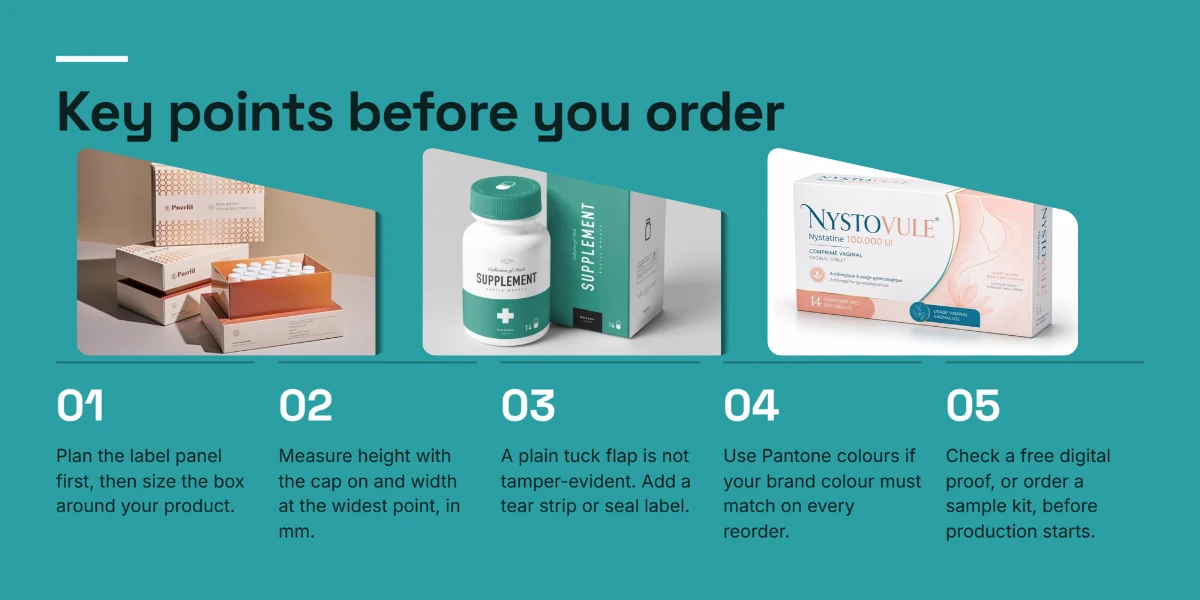
Key points before you order
How does a supplement carton actually work?
A supplement carton is secondary packaging. That means it's the outer box that holds the primary pack, which is the bottle, tub or pouch itself.
Every carton starts as a dieline. That's a flat outline of the box showing where it will be cut and folded, a bit like a sewing pattern. Your artwork is placed on this outline, so the ingredient panel lands on one side and not across a fold.
Next, the board is printed in large sheets. Each sheet is then cut and creased so the box folds cleanly along the right lines. Some styles, such as crash-lock bases, are glued at this stage. The boxes reach you flat, which saves space and delivery cost, and you fold them up when you pack.
An insert is an extra card piece inside the box. It holds a bottle still, much like the tray that keeps chocolates in place. Inserts are especially useful for dropper bottles, which are tall and easy to tip over.
Which carton style suits which supplement?
The product format points you to a sensible starting style. Use this table as a first shortlist, then ask our team to confirm it for your exact container.
| Product format | Good starting style | Board | Tamper-evident option |
|---|---|---|---|
| Capsule or tablet bottle | Reverse tuck end, or crash-lock base for glass | White SBS | Tear strip or seal label |
| Dropper bottle | Tuck-end with a card insert | White SBS | Seal label |
| Powder tub | Crash-lock base or sleeve | White SBS or kraft | Seal label |
| Sachets and stick packs | Tuck-end or pillow box | White SBS or kraft | Tear strip |
| Blister strips | Slim tuck-end with leaflet room | White SBS | Tear strip or seal-end |
| Subscription or multi-product kit | Mailer box | Corrugated E-flute | Seal label |
Dropper bottle boxes have a lot in common with skincare packaging. If you also sell serums or oils, our cosmetic packaging range and our guide to custom serum boxes show how inserts and finishes work for similar bottles.
Common mistakes and how to fix them
These five habits cause a lot of trouble with food supplement boxes. Each one has a simple fix.
| Mistake | What goes wrong | Fix |
|---|---|---|
| Sizing the box before planning the label | The ingredient list ends up in tiny type | Draft the label panel first, then size the box |
| Box too loose | The bottle rattles and the box feels poorly made | Measure at the widest point and ask for the right clearance, or add an insert |
| Calling a plain tuck flap tamper-evident | The flap reopens with no trace | Add a tear strip or seal label |
| Foil or heavy effects near the barcode | The scanner may struggle to read it | Keep the barcode on a plain, light panel with clear space around it |
| Skipping the proof or sample | Colours or fold positions surprise you after printing | Check the free digital proof carefully, or order a sample kit |
Pro tips for supplement packaging boxes
These small choices make reorders easier and keep a growing range looking consistent.
- Use one box family for your range. Keep the same panel layout across flavours and strengths, and change only the colour band and product name. Your shelf looks organised, and new products are faster to design.
- Leave a plain area for batch and expiry codes. These are often added after printing, so they need a clean spot with no varnish.
- Start small if you're testing. Orders start from 50 boxes, which suits a launch or a flavour test before a bigger run.
- Pick one hero finish. A single foil logo on matte board usually looks more confident than foil, spot UV and embossing all at once.
- Think about the whole shelf. If you supply shops, our retail boxes page covers window, sleeve and pillow styles that display well.
Do you sell medicines or pharmacy lines as well? Our medicine box checklist covers leaflets, labelling space and tamper features in more depth.
What should you send us for a quote?
Send the product, the size in mm and the quantity, and we'll reply with a quote within the hour. The more detail you include, the more accurate the quote will be.
- Product and container type (bottle, tub, sachets, blister strips)
- Container size in mm: height, width and depth
- Quantity, starting from 50 boxes
- Board preference: white SBS, kraft or corrugated
- Finish ideas, such as matte, soft-touch or foil
- Tamper-evident feature: tear strip or seal label
- Leaflet inside: yes or no
- How it reaches customers: shop shelf or post
There are no die or plate charges, and every quote is itemised, so you can see where each part of the cost comes from. The price depends on style, size, board, print, finish and quantity. One packaging specialist looks after your order from quote to delivery. You can see the full range, including supplement and vitamin boxes, on our pharmaceutical packaging page.
Frequently Asked Questions
What type of box is best for supplement bottles?
A folding carton in white SBS board suits most supplement bottles. Use a reverse tuck end for light plastic bottles. For heavier glass bottles, choose a crash-lock base, and add an insert if the bottle is tall or has a dropper.
How do I work out the right box size for my supplement bottle or tub?
Measure the container in mm at its tallest and widest points, then add a small clearance. Include the cap or lid in the height, and measure a tub's lid as well as its body. Our team will confirm the exact clearance for your board and style.
Can a supplement box be tamper-evident?
Yes, with a tear strip, a seal label or a glued seal-end. Each one leaves a clear sign once the box is opened. Tamper-evident is not the same as tamper-proof, so describe the feature rather than promising the box can't be opened.
Is a tuck flap tamper-evident?
No, a plain tuck flap is not tamper-evident on its own. It can be opened and closed again with no trace. Add a tear strip or a seal label if you need opening to show.
What information goes on a supplement box?
Usually the product name, ingredients, directions, warnings, batch number, expiry date and a barcode. Your brand supplies the approved wording, and we make sure the box has enough space to print it clearly.
What is the minimum order for custom supplement boxes?
Orders start from 50 boxes, and the exact quantity is confirmed with your quote. That makes small launches and flavour tests practical.
How long does it take to print custom supplement boxes?
Most orders are produced in 8–12 working days after proof approval, plus delivery time. Rush production can often be arranged, so tell us your date when you ask for a quote.
Ready to create your boxes?
Start with your label, measure your product in mm, and pick a style that suits how it reaches your customer. We'll help with the rest, from the dieline to the free digital proof. Our customers always come first, and our quotes come with no surprises.
Get a free quote within the hour, from 50 boxes, with free design support and free UK delivery to England, Scotland, Wales and Northern Ireland.