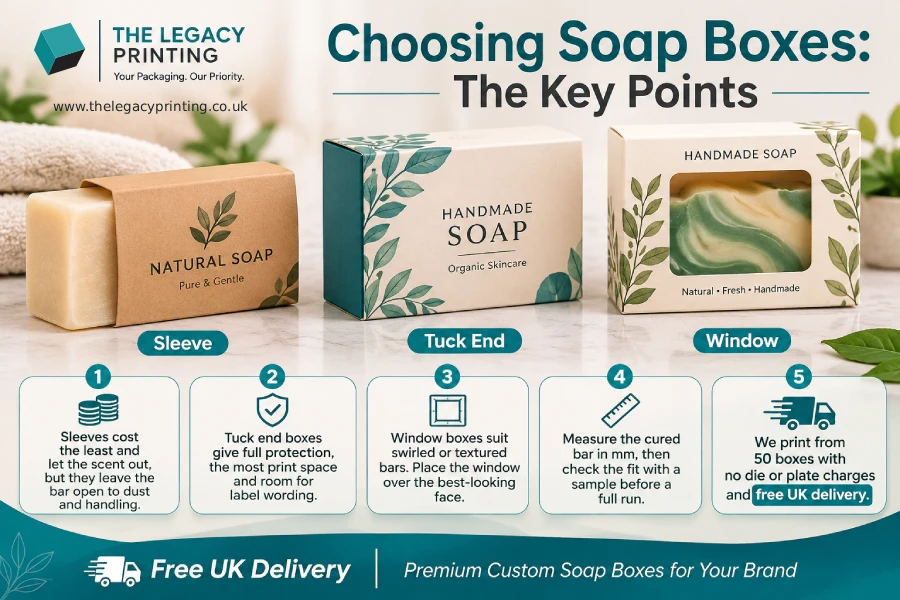
Many soap makers start by asking which box looks nicest. That's a fair question, but your bar usually answers it for you. Its shape, its surface, its scent and where you sell it all point to one style over the others.
So here's the short version for custom soap boxes. Pick a sleeve if you want the lowest cost and a scent people notice at a market stall. Pick a tuck end box if you sell on shop shelves or post your soap, and you need full cover and label space. Pick a window box if your bar has swirls, layers or texture worth showing off. Soap sits alongside creams and serums as a cosmetic product, so our custom cosmetic packaging range is a good place to see the styles in real life. Below, we walk through three example situations, then cover sizing, board, finishes and how a small run works.
Which soap box style should you pick?
Start with what your bar needs most: low cost, full protection or visibility. Each of the three main styles is strong in one of those and weaker in the other two.
One-line rule for sleeve, tuck end and window
- Sleeve: lowest cost, lightest and good for scent, but the ends of the bar stay open.
- Tuck end: fully closed, with the most print area. Best for retail and delivery.
- Window: shows the soap itself, with a little less print space and protection than a closed box.
A sleeve (also called a holster box) is a paper band that slides over the middle of the bar. A tuck end box is a closed carton with flaps that tuck in at the top and bottom. A window box is a carton with a hole cut in one panel, so shoppers can see the soap inside.
Custom soap boxes compared: sleeve, tuck end and window
If you want one safe all-round choice, go for a tuck end box. Sleeves win on cost, and window boxes win on looks. The table sets out the trade-offs side by side.
Comparison table
| Feature | Sleeve (holster) | Tuck end box | Window box |
|---|---|---|---|
| Cost level | Lowest | Medium | Medium, a little more if filmed |
| Protection | Low: ends are open | High: fully closed | Good, lower with an open window |
| Print area | Small band | All six panels | Five panels plus part of one |
| Shelf look | Natural, handmade | Clean and branded | Shows the real product |
| Craft-fair use | Very good | Good | Very good |
| Can the scent escape? | Yes, freely | Very little | Yes with an open window, less with film |
| Room for label wording | Tight | Plenty | Good |
What each style does best
A sleeve lets a buyer smell the bar before they pay, and at a market that often makes the sale. A tuck end box keeps the bar clean and gives you space for your logo, your story and the label wording a cosmetic product needs. A window box lets a beautiful bar speak for itself, because shoppers see the real colours and pattern.
Where each style falls short
A sleeve leaves the bar open to air and fingers, so on a busy table the soap can sweat or pick up dust. A closed tuck end box hides the scent. A tester bar on the counter fixes that. An open window lets dust in, and a badly placed window can show the plainest side of your soap.
Choosing Soap Boxes: The Key Points
Three example situations: which box fits?
The quickest way to choose is to match the box to how and where you sell. The three situations below are made-up examples, not real customers. They're built around common questions soap makers have when they order packaging for the first time.
Situation 1: weekend craft fairs on a tight budget
Say you make plain, single-colour bars and sell them at weekend markets. You want a low cost per bar and a scent people notice as they walk past. Your options are a printed belly band (a thin paper strip wrapped round the bar), a sleeve or a full box.
We'd pick a kraft sleeve here. It costs less than a closed box, it slides on quickly, and the open ends let the scent out. For example, you could wrap each bar in thin paper first, then add the sleeve. The wrap keeps dust and fingerprints off without hiding the fragrance.
Situation 2: swirled bars going into gift shops
Now say your bars have bright swirls, and a gift shop has just agreed to stock them. The shop wants clean packs that stack neatly, with your details clearly printed. A sleeve looks loose on a shelf, and a plain closed box would hide your best feature.
The better choice is a reverse tuck end box with a filmed window. It stacks well, keeps the bar clean and still shows the swirl. If the front of the bar is uneven but the cut edge looks great, put the window on the side or end panel instead. Our retail boxes with die-cut windows are made for this kind of shelf.
Situation 3: a skincare brand adding a soap bar
Finally, say you already sell serums and creams, and soap is your newest product. You want a box that matches the rest of your range, down to the exact brand colour. Kraft won't show that colour accurately, and a sleeve would look out of place next to your other cartons.
Go for a white board tuck end box printed in your Pantone colour, with foil or soft-touch to match your other packs. Your whole line then looks like one family on the shelf. You'll find matching styles on our custom cosmetic packaging page.
Decision table: situation to box
| Your situation | Best style | Board | Why |
|---|---|---|---|
| Markets and fairs, low budget | Sleeve with paper wrap | Kraft | Low cost, scent comes through |
| Swirled or layered bars in shops | Reverse tuck end with filmed window | Kraft or white | Shows the bar, stays clean |
| Plain bars, strong branding | Tuck end, fully printed | White | Most print space |
| Skincare range with set colours | Reverse tuck end with foil or soft-touch | White | Exact colour match |
| Selling online | Tuck end inside a postal box | White or kraft, corrugated outer | Closed box survives delivery |
| Gift set of several bars | Rigid or folding gift box with insert | Rigid greyboard or white | Holds bars apart, feels special |
Sleeve boxes (holster style)
Sleeves suit rectangular bars, market sales and makers who want a natural look at a low cost. They only work well when the fit is right, so spend a little time on sizing.
Best for
Sleeves are a strong option for handmade soap packaging at fairs, in farm shops and as small add-ons with bigger orders. They use less board than a full box, which appeals to buyers who care about waste.
Fit and sliding clearance
Leave a small gap so the sleeve slides on without catching. This gap is called sliding clearance. If the sleeve is too tight, it scuffs the bar or tears. If it's too loose, the bar can drop out when someone picks it up. A sample is the easiest way to check the fit before a full run.
Pairing with wrap or tissue
Because the ends are open, many makers wrap the bar in thin paper or tissue first. The wrap keeps the soap clean and stops oil marks reaching the sleeve. You still keep the scent and the handmade feel.
Tuck end boxes: straight vs reverse
The tuck end box is the standard closed soap box and the natural choice for retail shelves. Once you've chosen it, there's just one decision left: straight tuck or reverse tuck.
In a straight tuck end box, the top and bottom flaps tuck in from the same side. In a reverse tuck end box, they tuck in from opposite sides. A reverse tuck gives a neater, flat front panel, so we usually suggest it for display. A straight tuck can be slightly quicker to pack by hand.
Why they suit retail
Tuck end boxes stack well, stand upright and keep the bar clean. Shops like them because they're easy to price-label and keep tidy. Some shops use hook displays, so if your stockist asks for a hanging pack, mention it when you request your quote and our team can talk you through the options.
Print space and label space
With six panels, you have room for your logo, your story and all your label wording. For soap, that wording often covers ingredients, weight, a batch number and the maker's name and address. Your brand supplies the approved text, and we plan space for it in the design from the start.
Window boxes
Choose a window box when the soap's colour or texture is your strongest selling point. Where you put the window matters just as much as having one.
Open or filmed window
A die-cut window is a hole cut in the board with a shaped metal blade. You can leave it open or cover it with clear film. An open window lets the scent through but leaves the bar exposed. A filmed window keeps the bar clean and stops fingers touching it. If you're selling custom soap boxes with a window in busy shops, film is usually the safer option.
Where to put the window
Put the window over the best-looking face of the bar. For a swirled bar, that's often the cut side rather than the stamped top. Keep the window well away from folds, because a hole too close to a fold can weaken the box or crease badly.
When not to use one
Skip the window if the bar is plain, if it sweats easily or if you need every panel for wording. In those cases, a boldly printed tuck end box will look better and work harder for your brand.
Kraft or white board: which suits soap boxes?
Kraft gives a natural, handmade look. White board gives bright, accurate colours. Let your brand style make the call.
Look and feel
Kraft board is brown paper board, and kraft soap boxes suit natural and small-batch brands. White board, also called SBS or folding boxboard, is smooth and bright white. It suits clean, modern and skincare-style brands.
Print results on kraft
Brown board makes bright colours look duller. On kraft, we suggest one or two Pantone inks, bold simple artwork or a foil logo. Pantone (PMS) is a single ink mixed to an exact shade. CMYK mixes four inks to make most colours, and it looks its best on white board. Fine detail can blur on uncoated kraft, so keep small text clear and simple.
Oily bars can also leave marks on uncoated kraft. A paper wrap inside the box solves this.
Recyclable and eco options
We offer recyclable and biodegradable boards with soy or water-based inks. Plain board with no film is the simplest to recycle. Lamination and film windows add a non-paper layer, so if recycling matters most to you, choose an open window and skip the lamination. See our eco-friendly boxes for the full choice, and our guide to recyclable vs compostable packaging to understand the difference between the two.
What size soap box do you need?
The right size is your cured bar plus a small allowance for fit. There's no single standard soap box size, so always measure your own bars.
Measure the cured bar (length, width, height in mm)
A cured bar is handmade soap that has dried and hardened, and it may have shrunk a little since cutting. Measure it at this stage, not straight from the mould. Use a ruler or callipers and write down three numbers in mm: length, width and height, in that order. Handmade bars vary, so measure a few from the same batch.
Single bar, multi-bar and round soaps
For a single bar, send us its largest measurements and we'll add the right fit allowance. For two or three bars in one box, an insert helps. An insert is a card piece inside the box that holds each bar in its own space. Round and oval soaps sit well in a tuck end box with an insert or in a two-piece box. Pillow and drawer styles work nicely for gift sets, and for seasonal sets you can browse our gift boxes.
Dieline and digital proof check
A dieline is a flat outline of the box that shows every cut and fold. We set it up for free, and your artwork goes on top of it. You then get a free digital proof to check before anything is printed. Changes to the proof are free too.
Finishes that suit handmade soap packaging
One well-chosen finish usually looks better than three. Pick the finish that suits your brand, then keep everything else simple.
Foil, embossing and debossing
Foil stamping presses a thin, shiny metallic layer, such as gold or silver, onto the board. It stands out well on kraft. Embossing raises a shape so you can feel it, and debossing presses it down into the board. A debossed logo on kraft gives a warm, handmade feel.
Spot UV and soft-touch
Spot UV is a shiny clear coat on just one area, such as your logo. Soft-touch lamination is a thin film that gives the box a velvety feel. Both work best on white board. Our guide to spot UV printing shows how it works.
Printing inside the box
A short thank-you note or a usage tip inside a tuck end box makes opening it feel more personal. Whether inside printing suits your order depends on the box style and board, so mention it when you ask for your quote and we'll include it in the price.
Common mistakes to avoid
Most soap box problems come from fit and artwork, not from the box style. Here are four common ones, and how to avoid them.
Ordering too early
If you measure fresh bars before they cure, the boxes can end up loose once the soap shrinks. Wait until the bar has fully hardened.
Tight fit or loose fit
A tight box scuffs the bar. A loose one lets it rattle or slip out of a sleeve. Ask for a sample and test it with a real bar.
Artwork near folds
Text or logos placed right on a fold can crack or look off-centre. Keep key artwork clear of folds and cut lines. We point out any problems like this on your proof.
Forgetting label space
Plan room for ingredients, weight, batch number and your address from the start. Squeezing them in at the last minute rarely looks good.
How ordering works with The Legacy Printing
You can order from 50 boxes, with free design support and free UK delivery. This is what happens between your first message and your boxes arriving.
From 50 boxes, no die or plate charges
Orders start from 50 boxes, and your exact minimum is confirmed with your quote. There are no die or plate charges, and every quote is clear and itemised. Your price depends on the style, size, board, print, finish and quantity. Larger brands can reorder in bulk when they need more.
Free design support and free digital proof
Our team helps with design and sets up your dieline for free. You get a free digital proof, and any changes to it are free. One packaging specialist looks after your order from quote to delivery.
8–12 working days after proof approval, free UK delivery
Most orders are made in 8–12 working days after you approve the proof, plus delivery time. Rush production can often be arranged. Delivery is free to England, Scotland, Wales and Northern Ireland, and your boxes arrive flat to save space.
Sample kit
A sample kit lets you test the fit and the board before a full run. We follow up sample requests within 2 hours. If you plan to post your soap, our guide to postal box sizes helps you choose an outer box. New customers also save 20% on their first order.
Frequently Asked Questions
What are the most common styles of soap box?
The most common styles are sleeves, tuck end boxes and window boxes. Two-piece, pillow and drawer boxes are popular choices for gift sets.
Which is better for soap: a sleeve, a tuck end box or a window box?
It depends on where you sell. Sleeves suit low-cost market sales, tuck end boxes suit shops and delivery, and window boxes suit bars with eye-catching swirls or texture.
What size box do I need for a handmade soap bar?
You need a box sized to your cured bar plus a small fit allowance. Send us your measurements in mm and we'll work out the right size.
How do I measure soap for packaging?
Measure the fully cured bar in mm: length, then width, then height. Check a few bars from the batch and use the largest numbers.
Are kraft soap boxes recyclable?
Plain kraft board is easy to recycle where paper and card are collected. Film windows and lamination add a non-paper layer, so leave them off if recycling is your top priority.
Can you order soap boxes in small quantities?
Yes. We print custom soap boxes from 50 boxes, and there are no die or plate charges, so small runs stay simple to price.
Can you print inside the box?
Ask our team when you request your quote. Inside printing depends on the box style and board, and it's a nice spot for a thank-you message, care tips or a pattern.
Next step: get your quote
Tell us about your bar, its size in mm, how many boxes you need and the look you have in mind. We'll recommend the right style and board, and send you a clear, itemised quote. Our customers always come first, so there are no surprises on price.
Ready to create your boxes? Get a free quote within the hour — from 50 boxes, with free design support and free UK delivery.