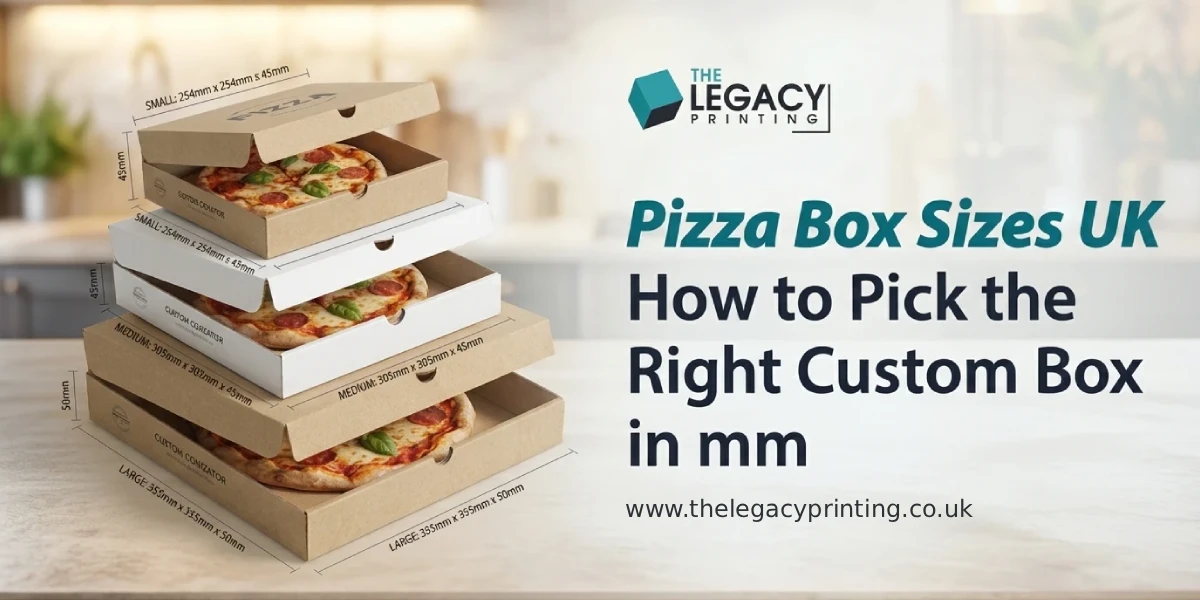
Picture a busy Friday night. A 12 inch pizza comes out of the oven a little wider than planned, and the lid won't shut on the box you just bought. Staff have to squash the crust or hunt for a bigger box, and the queue grows while they do it.
The quick answer is simple. A 12 inch pizza is 304.8 mm across, so custom pizza boxes for it should be about 320 mm inside and about 50 mm deep. For small and medium pizzas, E-flute corrugated board in white or kraft is a strong all-round choice. Move up to B-flute for 14 inch and larger pizzas, heavy toppings or deep-pan bases. The thicker board resists crushing better.
Below, we compare sizes, boards, shapes and print methods side by side, and explain why each choice matters. If you'd like to see the styles first, browse our custom food boxes.
What size is a 12 inch pizza box in mm?
A box for a 12 inch pizza needs an inside size of about 318 to 330 mm, and 320 mm is a common choice. The pizza itself is 304.8 mm across. That extra space lets staff slide it in, and lets your customer lift it out without tearing the crust.
Pizza size vs box size
The number on a pizza is its width, also called its diameter. The box has to be a bit bigger. One common rule from box makers is to add about 13 to 25 mm to the pizza's width. Another method adds 15 mm for space, then about 5 mm for tolerance.
Tolerance means a small safety gap. Machines cut and fold board very accurately, but never perfectly to the last millimetre. A few spare mm stop a snug fit from turning into no fit at all.
Ovens add another twist. A pizza baked in a 12 inch pan can come out about 12.5 inches wide, which is 317.5 mm. So a box with exactly 304.8 mm inside will often be too small, even before you add toppings.
Why inside and outside sizes differ
The inside size is the space for your pizza. The outside size is a little bigger, because the walls of the box have thickness. It works like a coat: the coat is always bigger than the person wearing it.
Suppliers label boxes in different ways. Some call a box "12 inch" because it holds a 12 inch pizza. Others give the outside size, such as 13 x 13 x 2 inches. If you don't ask which one they mean, you can end up with the wrong box. When you order from us, we work to the inside size of your product, and your free digital proof shows the exact measurements.
Pizza box sizes: a size chart in mm
UK suppliers commonly list pizza box sizes from 7 to 16 inch, and some go up to 18 inch. Smaller sizes suit personal pizzas and sides. The middle sizes suit medium pizzas, and the largest suit family and sharing pizzas. The table turns each pizza size into mm and gives a suggested inside size, depth and board.
The inside sizes for 7, 9, 10 and 18 inch pizzas use the "add about 20 mm" method above. Treat them as a starting point, then check them against a real baked pizza from your own oven.
| Pizza size | Pizza width (mm) | Suggested inside size (mm) | Depth (mm) | Good board choice | Typical use |
|---|---|---|---|---|---|
| 7 inch | 177.8 | about 195–200 | about 50 | E-flute | Personal pizzas, sides |
| 9 inch | 228.6 | about 250 | about 50 | E-flute | Personal pizzas, kids' meals |
| 10 inch | 254 | about 275 | about 50 | E-flute | Medium pizzas |
| 12 inch | 304.8 | about 320 | about 50 | E-flute or B-flute | Medium to large pizzas |
| 14 inch | 355.6 | about 370 | about 50 | B-flute | Large pizzas |
| 16 inch | 406.4 | about 420 | about 50 | B-flute | Family pizzas |
| 18 inch | 457.2 | about 477 | about 50 | B-flute | Party and sharing pizzas |
| Deep-pan (any size) | Measure after baking | Pizza width + about 20 | about 63–76 | B-flute | Thick and pan pizzas |
Inch to mm: multiply by 25.4
If you still think in inches, one sum does the job. By international definition, 1 inch is exactly 25.4 mm, so mm = inches × 25.4. For example, a 14 inch pizza is 14 × 25.4, which gives 355.6 mm. Working in mm also matches how box makers cut board, so there's less room for rounding errors.
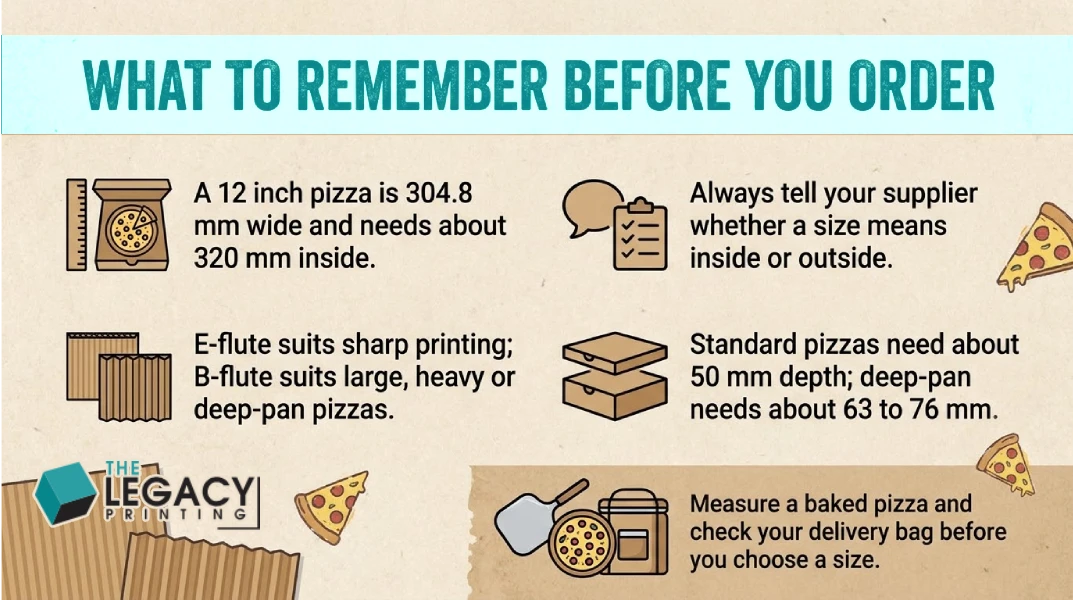
What to remember before you order
How to measure your pizza and pick your size
Measure a real, baked pizza, add about 20 mm, then check that the box fits your delivery bag. Those three steps prevent most sizing problems.
Measure a baked pizza, not the pan
Dough spreads as it cooks, a bit like a pancake in a hot pan. Bake a normal pizza, let it settle for a minute, then measure across the widest point in mm. Measure two or three pizzas from a busy shift, because hand-stretched bases are never quite the same.
Add a small gap and tolerance
Add about 15 mm for easy loading and about 5 mm for tolerance. If your bases often come out uneven, lean towards the top of that range. Why go bigger rather than smaller? A loose pizza slides a little, but a tight one tears when staff lift it out.
Check your delivery bag
An insulated delivery bag is the padded thermal bag a courier carries. Standard ones usually take boxes from 12 to 16 inches, which is about 305 to 406 mm. Measure the inside of your bags before you order 18 inch boxes. Otherwise you may need new bags too.
Deep-dish and pan pizza depth
A standard pizza fits a box about 50 mm deep. Deep-dish, pan and thick-crust pizzas need about 63 to 76 mm. If the box is too shallow, the lid presses into the cheese. If it's too deep, you pay for board you don't need, and the box takes up more room in the bag.
Which board is best: E-flute, B-flute or kraft?
E-flute is best for sharp printing on small and medium pizzas. B-flute is best for large, heavy or deep pizzas. Kraft isn't a separate strength level. It's a natural brown colour and finish, and it comes in both flute types.
All three are corrugated board. That's cardboard with a wavy layer, called a flute, glued between two flat sheets. The waves act like a row of small arches, which is why a thin sheet can hold its shape under weight. Taller waves give a thicker, stronger board.
Comparison table
| Feature | E-flute | B-flute | Kraft (E or B flute) |
|---|---|---|---|
| Board thickness | About 1.2–1.6 mm | About 2.5–3 mm | Depends on the flute |
| Strength | Good for 7–12 inch | Better for stacking and big pizzas | Same as the flute you pick |
| Print quality | Smoother face, sharpest logos | Good, slightly less crisp | Natural brown; colours look softer |
| Storage space (flat) | Less | More | Same as the flute you pick |
| Cost level | Less board per box | More board per box | Depends on print and finish |
| Best for | Branded boxes, slice boxes, medium pizzas | 14–18 inch, heavy toppings, deep-pan | Artisan, rustic or eco look |
The exact cost depends on size, board, print, finish and quantity. Your itemised quote lists each part, so you can see what moves the price.
E-flute: pros and cons
Pros: a smooth surface for crisp logos, a lighter box, and flat stacks that take up less space in a small kitchen.
Cons: less crush strength. We wouldn't pick it first for 16 inch pizzas or tall stacks on a delivery bike.
B-flute: pros and cons
Pros: more crush strength, which matters when boxes are stacked high in a bag or on the counter. It also keeps its shape better under heavy, wet toppings.
Cons: it takes more storage room when flat, and very fine print detail looks a little less sharp.
Kraft: pros and cons
Pros: a warm, natural look that suits wood-fired and artisan brands. One or two dark ink colours look great on it.
Cons: bright colours and photos look duller on brown board, the way coloured pens look faint on brown paper. If your logo depends on a bright red, white board is usually the better choice.
Heat, grease and eco-friendly options
Hot pizza gives off steam, and trapped steam turns a crisp base soft. Vent holes are small holes in the box that let that steam escape. Grease is the other issue. A grease-resistant coating is a thin layer that slows oil soaking into the board. Ask our team which board and coating suit your food and your menu.
If recyclability matters to your customers, we offer recyclable and biodegradable boards with soy or water-based inks. You can see the range on our eco-friendly boxes page.
Box styles: square, slice, hexagonal and custom die-cut
A square box is the safest choice for daily trade. Other shapes earn their place when you want people to notice your brand, for example at a launch, an event or a seasonal offer.
- Square box: easy to fold, stack and fit in a delivery bag. It suits almost every pizza.
- Slice box: a small box that holds one slice for counter sales. Smooth white folding boxboard (SBS) works well for slim slice cartons.
- Hexagonal or octagonal box: a six- or eight-sided box. It stands out on the counter and in photos, so it suits promotions more than everyday delivery.
Sauce pot and side holders
A die-cut feature is a shape cut into the board. A common one is a holder for a dip pot, so the sauce stays put instead of sliding onto the pizza. Because we don't charge for dies, a custom cut like this doesn't add a tooling fee to your quote.
Window and vent options
Vent holes are the practical choice for hot delivery. A die-cut window on the lid lets customers see the food, which works well for counter sales. But every opening lets heat out, so keep windows small if your boxes travel far.
Custom pizza boxes with your logo: printing and finishes
Pizza boxes with your logo work hard, because the box is the one thing every customer holds. The lid is the obvious place to start. Ask about printing on the sides or inside when you request your quote.
Where to put the logo
The lid is your billboard, because it's what people see on the table. The sides show when boxes sit in a stack on the counter or in a delivery bag. The inside of the lid is a surprise space for a short message, your menu web address or a "thanks for ordering" note.
CMYK vs Pantone
CMYK uses four inks (cyan, magenta, yellow and black) that mix to make most colours, much like mixing paints. It's great for photos and full-colour designs. Pantone, also called PMS, uses ready-mixed ink in one exact shade, like buying a tin of paint by its code. If your logo is one bold colour, Pantone keeps it the same from order to order.
Offset vs digital printing
Digital printing suits small runs and quick design changes, such as personalised pizza boxes for a wedding, a birthday or a party. Offset printing suits bigger runs, so it's the usual choice when a busy pizzeria reorders wholesale quantities for daily trade.
Foil, embossing and spot UV
Foil is shiny metallic print, such as gold or silver. Embossing raises your logo so people can feel it with their fingers. Spot UV adds a glossy patch to one part of the lid, and you can also choose matte or gloss lamination. These finishes suit gift, event and premium boxes more than everyday delivery boxes. To see how a glossy logo can stand out, read our guide on spot UV printing for custom boxes.
Artwork and dieline
A dieline is the flat outline of your box, like a sewing pattern for a shirt. It shows where the board is cut and folded. Your artwork sits on top of it, so a logo near a fold doesn't end up bent in half. Our free design support sets this up for you. Then the free digital proof lets you check everything before printing, and changes to the proof are free.
Which should you choose?
Match the box to how the pizza travels and how it's sold. These quick picks cover most UK pizza businesses.
- If you sell 10–12 inch pizzas for delivery → choose E-flute, about 50 mm deep, with vent holes.
- If you sell 14–18 inch or heavily topped pizzas → choose B-flute for extra strength.
- If you sell deep-pan or thick-crust pizzas → choose B-flute at about 63–76 mm deep.
- If you want an artisan or eco look → choose kraft with one or two dark ink colours.
- If your logo is one exact colour → ask for Pantone printing.
- If you need boxes for a wedding, birthday or event → choose a short digital run, perhaps with foil on the lid.
- If you sell by the slice → choose a slice box in white board.
Running a bakery or café alongside your pizza menu? Our article on kraft box packaging for food businesses has more ideas.
Common sizing mistakes and how to avoid them
Most problems come from guessing the size instead of measuring it. Each mistake below is easy to fix before you order.
- Ordering the exact pizza width. A 304.8 mm box for a 12 inch pizza is too tight. Add about 20 mm.
- Ignoring oven spread and rise. Pan and hand-stretched bases grow as they bake. Measure a baked pizza.
- Forgetting the delivery bag. Check the bag's inside size before you pick 16 or 18 inch boxes.
- Mixing up inside and outside sizes. Always say which one you mean, in writing.
- Artwork that ignores the dieline. Logos on folds or flaps get cut or bent. Use the proof to check.
Checklist before you order
- Baked pizza width measured in mm
- Inside size and depth chosen
- Delivery bag size checked
- Board picked: E-flute, B-flute, kraft or white
- Vents, sauce holder or window decided
- Logo file ready, or design help requested
- Sample kit requested if you want to feel the board first
Can you recycle a greasy pizza box?
Usually yes, if there's only a little grease. Heavy oil and stuck-on food can stop a box being recycled. Grease makes the paper fibres cling together, so they can't be pulled apart and made into new paper.
Clean lid vs greasy base
A simple tip helps your customers. Recycling advice often suggests tearing off the clean lid for recycling and dealing with a very greasy base separately. Flattening the box first saves bin space too.
Check local council rules
Rules differ from one area to another, and some councils don't take pizza boxes in kerbside bins. A short line inside the lid, such as "Clean lid? Please recycle it", gives customers a clear prompt without promising anything about their local rules. For the bigger picture, see our guide on recyclable vs compostable packaging.
Ordering custom printed pizza boxes from The Legacy Printing
We've been making custom packaging in London since 2016. Orders start from 50 boxes, and the minimum is confirmed with your quote. There are no die or plate charges, and every quote is clear and itemised.
- Quick quotes: we reply to quote requests within 1 hour.
- Free help: free design support and a free digital proof, with free changes to the proof.
- Production time: most orders take 8–12 working days after proof approval, plus delivery time. Rush production can often be arranged.
- Free UK delivery: to England, Scotland, Wales and Northern Ireland.
- Delivered flat: boxes arrive flat, which saves storage space in your kitchen.
- One contact: one packaging specialist looks after your order from quote to delivery.
Browse our custom food boxes to see the styles and boards we print. Then tell us your pizza size, depth, quantity and finish, and we'll suggest the right box.
Frequently Asked Questions
What size is a 12 inch pizza box in mm?
Aim for about 320 mm inside and about 50 mm deep. The pizza is 304.8 mm wide, so the extra room helps staff load it and covers small differences in cutting and folding.
How much do custom pizza boxes cost?
We don't give a fixed figure, because the price depends on your box. Size, board, print colours, finishes and quantity all change it. Your itemised quote shows each part, with no die or plate charges.
Can I get custom pizza boxes with no minimum?
Our orders start from 50 boxes, and the minimum is confirmed with your quote. That small starting point suits events, trial menus and new takeaways.
How do you print on pizza boxes?
Your artwork is placed on a dieline, then printed by digital or offset printing in CMYK or Pantone. We set up the dieline for free, and you approve a free digital proof before production.
Can you print inside the box?
Ask about inside printing when you request your quote, and our team will tell you what suits your box style. Brands often use the inside of the lid for a thank-you message or a recycling note.
How long do custom printed pizza boxes take?
Most orders take 8–12 working days after you approve the proof, plus delivery time. Rush production can often be arranged, so ask when you request a quote.
Are custom pizza boxes worth it?
For most pizza businesses, yes, because the box is the one thing every customer holds. A box in the right size protects the pizza, and your logo on the lid keeps your name on the table.
Get the right pizza box first time
Measure a baked pizza, add about 20 mm, and choose a depth that suits your crust. Pick E-flute for small and medium pizzas and B-flute for large, heavy or deep ones. Then let the proof catch the small details before anything is printed. Our customers always come first, and we'll help you get the size right.
Ready to create your boxes? Get a free quote within the hour — from 50 boxes, with free design support and free UK delivery.